
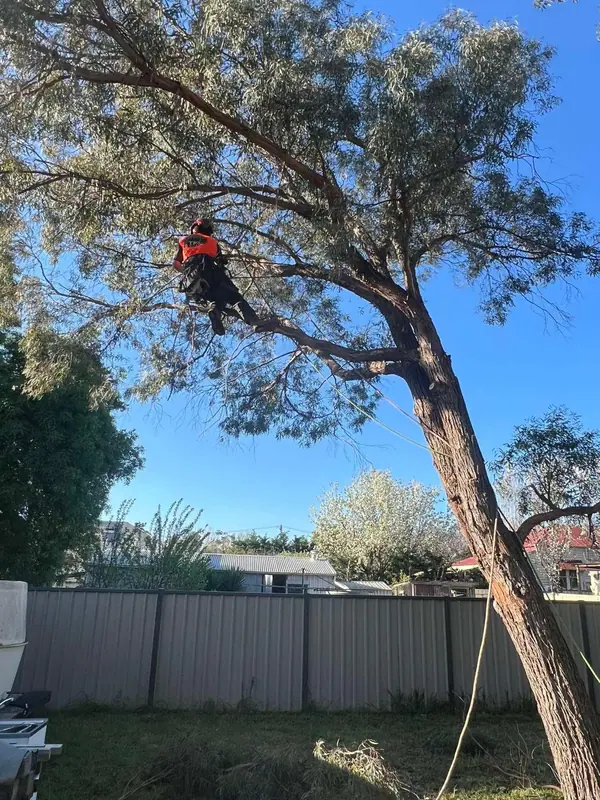
A tree surgeon and an arborist do the same job. Both names describe someone trained to climb, prune, assess and take down trees safely. "Tree surgeon" is the older name and is still common in the UK, while "arborist" is the word most Victorians use now, and it is what the training is called here. So when you search for a tree surgeon in Bendigo, you are really looking for a qualified, insured arborist. The name matters far less than what sits behind it.
Is a tree surgeon the same as an arborist?
For a homeowner, yes. Both terms cover the person who comes out, looks at your tree, works out what it needs and then does the work with ropes, saws, a lift or a crane. The British have called that trade tree surgery for a long time, which is why the phrase still pops up in Australian searches and on the odd old truck door. In Australia the trade and its training are called arboriculture, so most people in the industry call themselves arborists.
You will also hear "tree lopper", and that one is worth a second look. Lopping, in the old sense, meant cutting branches off wherever was easy without any thought for how the tree would respond. A good arborist cuts back to a healthy branch or the collar where the tree can seal the wound. If someone describes the job as lopping, ask them to explain where and how they plan to cut. Our post on tree lopping versus pruning in Bendigo goes into why that difference shows up years later.
What does an arborist actually do on a Bendigo job?
Most of the work falls into a handful of jobs, and on a lot of days we do two or three of them on one block:
- Pruning. Deadwood out, limbs shortened back off a roof or a fence, crowns thinned so wind moves through. Our tree pruning service in Bendigo covers how we go about it.
- Removal. Taking a tree down in sections when there is a house, shed or powerline underneath, or felling it whole when there is room.
- Assessment. Looking at a tree that worries you and telling you plainly whether it needs work, needs watching, or is fine.
- Stump grinding and clean-up. Chipping the branches, grinding the stump and leaving the yard tidy.
- Emergency work. Making a tree safe after a storm drops a limb on a roof or across a driveway.
Around here that usually means big old gums. Red gums, yellow box and ironbark grow huge on Bendigo blocks, and plenty of them were standing long before the houses were. They drop limbs, they lean over sheds, and they need someone who knows how a eucalypt reacts to a cut. That local knowledge is a bigger part of the job than the title on the ute.
What qualifications should a tree surgeon in Bendigo have?
The core qualification for an arborist doing pruning and removal work in Australia is the Certificate III in Arboriculture. Above that sits the Diploma of Arboriculture, the level 5 qualification held by consulting arborists who write tree reports and assessments. The City of Boroondara's advice on choosing an arborist suggests asking about exactly those two levels, plus on-the-job experience, before you hire anyone.
On top of the certificate, the crew should hold tickets for the gear they use. Chainsaws, climbing and the elevated work platform all carry their own training. At TB'S Trees our crew is trained and ticketed for chainsaw and EWP work, and pruning is done in line with Australian Standard AS 4373, the national standard for pruning amenity trees. If you want the longer story of who we are and how we train, it is on our about page.
What you do not need for most home jobs is a consulting arborist's report. That comes into play when a council, a builder or an insurer asks for a written assessment, or when a tree is near a development site and the protection standard for trees on building sites applies. For a gum that needs its deadwood out, a qualified working arborist is the right person to call.
What does "qualified and fully insured" mean in practice?
It is easy to put those words on a website, so here is what they should mean when someone turns up at your place.
Qualified means the person in the tree has been trained to climb and cut safely, and the person quoting the job knows enough about trees to tell you when work is not needed. Ask what training the climber has and who will actually be on site.
Fully insured means public liability cover that pays out if a limb comes down on your roof, your car or your neighbour's fence. Boroondara's guide also lists products liability and, for consulting work, professional indemnity. Any business doing tree work should be happy to show you a current certificate of currency. If the answer is vague, keep looking. A cheaper quote from someone without cover can become very expensive the moment something goes wrong.
Questions to ask before you book anyone
What qualifications does the climber hold? Can I see your public liability certificate? Will you take the green waste away or leave it chipped on site? Is the stump included? Does this tree need a permit? A good arborist answers all five without fuss.
When do you need an arborist rather than a handyman?
Trimming a small hedge or a fruit tree you can reach from the ground is fair game for most people with decent tools. The line is height, weight and what is underneath. Call an arborist when:
- You would need a ladder and a chainsaw at the same time. That is the classic injury combination.
- A limb is bigger than your leg, or hangs over a roof, shed, pool or driveway.
- The tree is anywhere near powerlines. Leave that to people trained for it.
- The tree is dead, leaning harder than it used to, cracked, or dropping limbs.
- You are not sure whether the tree is protected or needs a permit before anything is cut.
On that last point, our guide to tree removal permits around Bendigo walks through how to check your block before any saw starts.
Strathfieldsaye, Maiden Gully and the bush blocks
A lot of our calls about big trees come from the bigger blocks on the edges of town. In Strathfieldsaye it is often a stand of old gums left in place when the estate went in, now leaning over a back fence or a new pergola. Our Strathfieldsaye arborist page covers what we do out that way.
Maiden Gully is similar, with more bush around the houses and more trees that have never had any pruning at all. Deadwood builds up, limbs get long and heavy, and the first sign of trouble is often a branch on the lawn after a hot still afternoon. The Maiden Gully tree services page has the local detail. Whether you call it a tree surgeon or an arborist, the job is the same: get a trained person up there before the tree makes the decision for you.
How do you pick the right arborist in Bendigo?
Start with reviews from people near you, then talk to the person who will do the work. A few things separate a good operator from a risky one:
- They come out and look at the tree before giving a firm price.
- They explain the plan: which limbs, where they will drop, how the green waste leaves.
- They are upfront about insurance and happy to put it in writing.
- They will tell you when a tree does not need work, even though that costs them a job.
- Their quote spells out the clean-up, the stump and the wood, so nothing turns up later as an extra.
For tree removal you can get a ballpark straight away with our instant removal price, and for pruning we will come and have a look. Either way, the Bendigo pruning page and the tree removal service in Bendigo show how we run each job.
Frequently asked questions
Need a tree looked at?
Send a photo or two of the tree and tell us what is worrying you. Tom will tell you straight whether it needs pruning, removal or nothing at all. Call 0498 609 887 or send the details through our contact page. Family-owned Bendigo arborists, qualified and fully insured.